

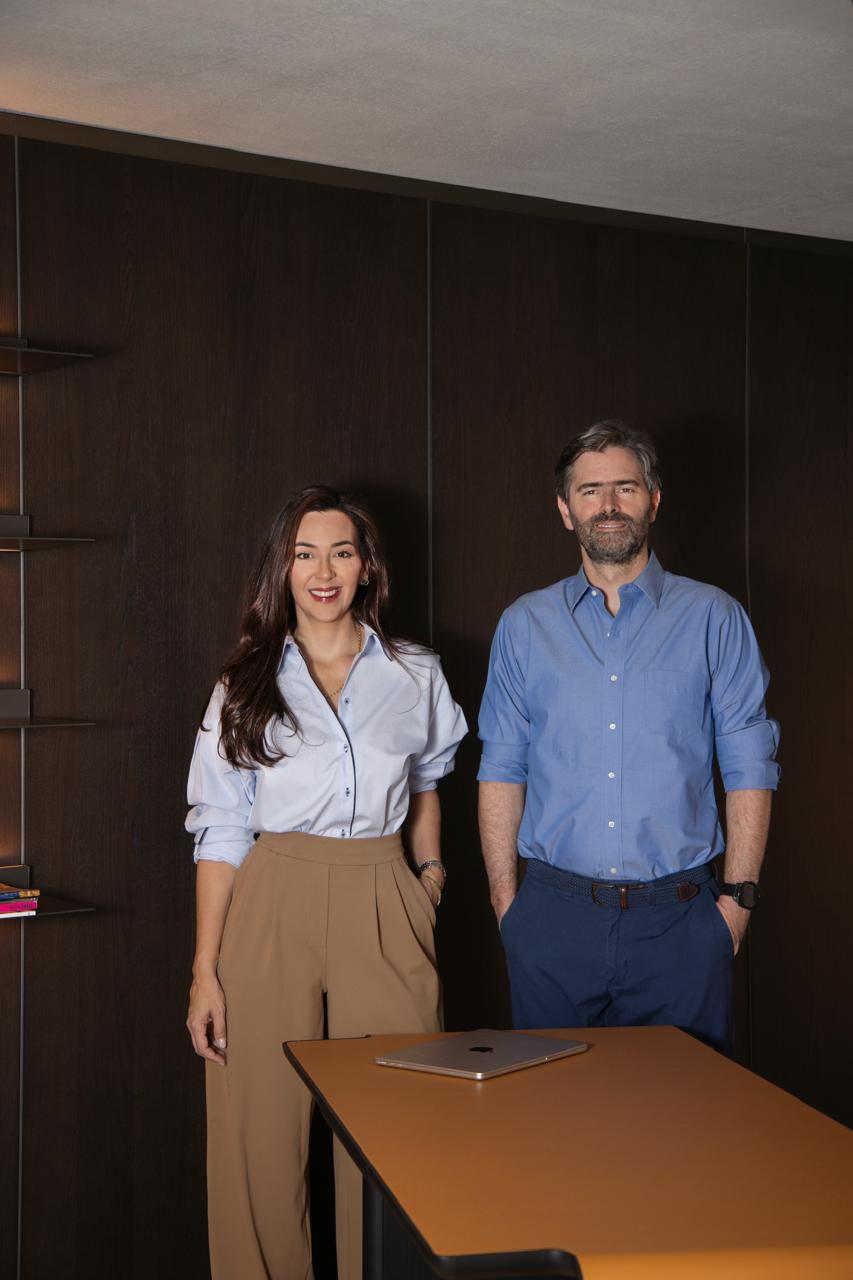
We celebrate Olga Lucía Rodríguez Pérez, KCP Class of 2002, who has transformed her experience in design, brand strategy, and creative leadership into an innovative entrepreneurial venture. Co-founder of UpPipe and founder of Brandnew Studio, Olga Lucía studied at Universidad Jorge Tadeo Lozano and pursued studies in business, finance, and marketing at Columbia University.
Through UpPipe, the company she built alongside her husband and business partner, Alberto McAllister, she has developed a model that combines artificial intelligence with creative talent to help marketing teams manage peak workloads and expand their production capacity. Recently featured in Portafolio, their story reflects the creativity, perseverance, and teamwork behind turning a business challenge into an opportunity.
We had the pleasure of interviewing Olgui and revisiting the activities she participated in and led during her school years. It was a special opportunity to explore her journey and reflect on how the experiences, lessons, and relationships she built at KCP have helped shape her story.
Thank you, Olgui, for sharing your experience and inspiring new generations of Tigers to create, embrace entrepreneurship, and build their own paths!
Once a Tiger, Always a Tiger! 🐯
1. Looking back on your time at KCP, what experiences or values helped shape your creativity, entrepreneurial spirit, and leadership style? KCP gave me leadership opportunities I could never get today, not with clients, not with employees, not anywhere in the industry. I was captain of many sports teams. I was on StuCo from elementary school as a rep and sports coordinator, then vice president, and in high school StuCo president. I was in the Honor Society and Mu Alpha Theta. And KCP let us do a LOT. I did theatre, mostly set design. The yearbook staff, talent shows, fashion shows, bake sales, Halloween festivals, StuCo’s many activities. Every one of those was a small project to run, with a deadline, a budget, and a team. What matters is that KCP is where I first learned, and got it wrong a thousand times, what a bad leader and a good leader look like. School is where that skill is built and fed, because here you get to fail when failing is cheap. Organizing a fashion show or a Halloween festival teaches you things no class can. Nobody follows you because you know more. People follow you for your motivation, your trust in them, your empathy, your enthusiasm, your sense of fairness, your generosity, and above all your example. And the biggest lesson: to lead a team, you first have to be a team player. Before you are the captain, you have to be the MVP of showing up. That is why people trust you to lead them: because you have done it yourself, and failed, before. Being captain taught me the hardest part. Your abilities as a captain don’t show on a winning team. Anyone can lead when you are winning. They show in how you react, and how you get everyone up again after you have been crushed on the field. That is exactly what I do today. Every client meeting, every team decision, I am still using what I practiced in a school gym.
2. How would you explain what UpPipe does to a KCP student, and what makes its approach different? Think about StuCo in October… the week before the Halloween festival or Valentine’s Day. For most of the year, the team is fine with most activities. Then, suddenly, there are posters to make, booths to set up, tickets to sell, all at the same time. The team is the same size, but the work is three times bigger. Something gets done late, or badly, or not at all. Marketing teams in big companies live this every month. They need ads, social media posts, videos, presentations. And the work does not arrive evenly: it arrives in waves. UpPipe does two things: First, it sees the wave coming. We have been measuring creative work for fourteen years, more than 86,000 hours of it, so our software can tell a team “your rush is coming” before it arrives, and how many hours each piece will take before anyone starts. Second, when the team is not big enough, UpPipe brings in extra hands from a network of senior creative people. They arrive already knowing the brand’s rules, its colors, its tone, so it feels like the same team, just bigger. What makes it different: UpPipe takes care of everything operational. It organizes the requests, estimates the hours, assigns the work, keeps the brand rules at hand, and measures everything. That frees people to do what only people can do. The client asks for what they need and adjusts it. The project manager reviews and keeps the team motivated. The creative creates and gets inspired. A machine can make a hundred options. Knowing which one is right, and why, is human. That is judgment, and UpPipe exists so that it stays with people.
3. You built UpPipe alongside your husband and business partner. What has this taught you about teamwork, trust, and complementary skills? Alberto and I could not be more different, and that is the point. I come from advertising and creative work. I look at a piece and ask: does this stand out? He spent seventeen years running a flower export business. He looks at the same piece and asks: did we waste anything to make it? I see the story: the human, the creative, the intuitive. He sees the system: where AI adds real value, what AI could do better than us, and where it simply isn’t worth it. For years I thought my way was the right way. Building UpPipe taught me that the best teams are not made of people who think alike. They are made of people who trust each other enough to disagree. When we argue, the company usually wins, because each of us covers what the other one cannot see. Three things I have learned: • Divide clearly. Everyone needs to know what is theirs. Ambiguity is where couples and partners fight. • Respect the skill you do not have. It is easy to undervalue what you do not understand. • Trust is built in small promises kept, not in big speeches. Same as on a sports team. 4. What has been one of the biggest challenges in your entrepreneurial journey, and how has overcoming it changed the way you lead? For several years, our biggest client was most of our business. Then, almost overnight, it was gone. We went from about 29,000 hours of work a year to 146. That is not a dip. That is starting over. We did not close, lost a ton of money, and the reason surprised me. The one thing that survived intact was our record of everything we had done: every hour, every piece, every adjustment, measured for years. The years of documented work. That data became the foundation of UpPipe. The thing that saved us was not talent or luck. It was the experience, actual data from years of work. It changed how I lead specially. I learned that the worst moment is often where the next idea comes from. If you stay long enough in a hard place, and you keep asking honest questions, it starts to teach you something. I would not have built UpPipe if everything had kept going well.
5. As AI reshapes the creative industry, which human skills will become more valuable, and how can students start developing them today? AI is now very good at producing. It writes, it draws, it edits, in seconds. So the question is no longer “can you make it?” It is “can you tell if it is good?” That is judgment: knowing what good looks like, and being able to explain why. I believe it is the most valuable skill of this new human era. The data agrees. The World Economic Forum surveyed more than 1,000 employers worldwide in 2025. The top skills they want are analytical thinking (69%), resilience and flexibility (67%), leadership and social influence (61%), and creative thinking (57%). None of those are “use a tool.” All of them are human. But here is the warning. A study by Microsoft and Carnegie Mellon found that people who trust AI more than they trust themselves think less critically about what it gives them. People who are confident in their own skills check, question, and improve the AI’s answer. And an early MIT study, still under review, found that students who wrote essays with ChatGPT could barely remember what they had written. Students who wrote first on their own and used AI later did better. So judgment is not something you are born with. It is grown, like a muscle. How?
• Do it yourself first. Write your own draft, sketch your own idea, solve the problem your way. Then ask the AI. You need something to compare against.
• Always ask “why.” Why is this ad good? Why does this logo work? Why did the AI choose this word? Judgment is built by explaining your choices out loud.
• Look at a lot of great work. Your taste is only as good as what you feed it.
• Ask the AI to argue against you. Use it as a sparring partner, not an answer machine.
• Make mistakes when they are cheap. A failed school event teaches more than perfect homework. And the soft skills that make the difference are the same ones I learned at KCP: empathy, curiosity, fairness, enthusiasm, being a good teammate. AI cannot motivate a team at 11 pm before a festival. You can.
6. What advice would you give KCP students who have a business idea or want careers in design, marketing, or technology but don’t know where to start? Start smaller than you think, and start now. • Solve a problem you actually see. Most good businesses start with “this is annoying, someone should fix it.” Look around school. There is probably one right there. • Make something real this month. A logo for a friend’s project, a poster for a club, an Instagram for a school event. Real work with a real person waiting for it teaches faster than any course. • Use AI, but do not let it think for you. It is the best assistant you will ever have. It is a terrible boss. • Write things down and measure what you do. It sounds boring. It saved my company. • Find your opposite. The partner who is good at what you are bad at is worth more than ten people who agree with you. • Lead something at school. StuCo, a team, an event. It is the cheapest leadership training you will ever get. You do not need to know where you are going. You need to take the next step and pay attention to what it teaches you.
7. What are some of your favorite memories from KCP, and what message would you like to share with the community? I have to be honest: I had to pull out my yearbook to remember it all, and I laughed, because I was in everything. The theater scenery, the fashion show, the Halloween fest, the yearbook, softball, soccer, basketball, cheerleading. Not because I was the best at any of it, and definitely not the smartest. Let’s not talk about physics, chemistry, or calculus. I just loved being part of things and getting people excited about them. KCP gave me the space to develop skills I never knew I had. I also remember being terrified to give a speech in front of the whole assembly. People assume a StuCo president must be naturally confident. It’s not that I feel like a confident person, even today. I just learned to do it scared. After running for StuCo so many times, I started helping my friends and my cousins run too. We made the campaigns at home, and they asked me to help with their speeches, because I had already faced those fears. I had run and lost, and I had run and won. That makes the people around you feel that, whatever happens, it’s going to be OK. As the Olympic skier Eileen Gu said, so young: “It will never be embarrassing to try.”
Some of my best memories are of friends I admired. We met through sports, and they were a few years older than me. They are the reason I joined the Honor Society and Mu Alpha Theta. With them came the structure, discipline, and effort I never had in elementary or middle school, and with that came real academic excellence. Surround yourself with people who don’t just make you feel good about yourself, but make you want to be the best version of yourself. Those friendships start here, at school. And one memory I will never forget. I was the striker on our soccer team, and right before the Binationals in Manizales, I broke my ankle. I begged my parents to let me go anyway, because I had to be there for my team, even if I couldn’t play. Before the last game, I wanted to take the cast off and play. Our coach, Fonchi, stopped me. He told me I had a very big responsibility off the field, because this game was going to be really hard and my team was going to need me. Fonchi was a great coach who valued teamwork, leadership, and enthusiasm above everything else. That day I learned you can lead without playing. How I wish I could come back. I have never been happier in my life than I was at KCP.
My message to the KCP community: you are not going to know exactly what you want to do, and that is part of the journey. Nobody told me that a girl who organized fashion shows and yearbooks and captained sports teams would one day measure creative work for companies in twenty countries. But every one of those experiences was practice. To the students: be braver than your insecurities. Say yes to the things that scare you a little. Run for StuCo. Organize the event. Captain the team. And let yourself be vulnerable, because getting it wrong in front of people will teach you more about yourself than being accepted ever will. Then do it again, better. That is how judgment is born. To the teachers and parents: thank you for letting us fail in a safe place. In a world where a machine can give any answer, what you are really teaching is how to know which answer is right. That has never mattered more.
Links:


